
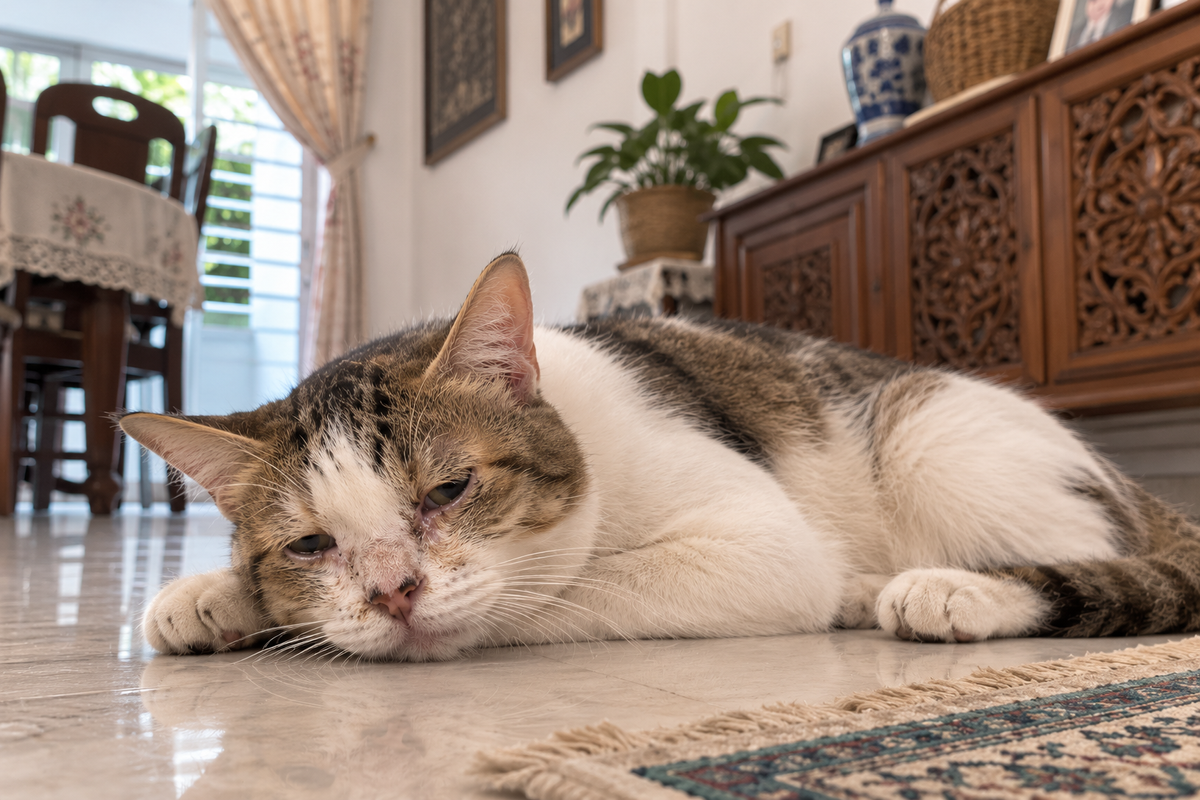
Key takeaway: Feline Infectious Peritonitis (FIP) is a serious viral disease in cats, but it is no longer a death sentence. Since 2019, more than 100,000 cats have been treated with GS-441524-based antivirals, and a UC Davis clinical trial reported a 92% success rate. If you spot early signs like a persistent fever, a swollen belly, or a kitten who stops growing, act quickly and speak with your veterinarian about a diagnosis and treatment path.
You are not the first Malaysian Pawrent to face those two frightening letters, F-I-P. Many families here have walked this road before you. This guide will help you understand the symptoms, how vets diagnose the disease, and what modern treatment looks like today.
What is Feline Infectious Peritonitis (FIP) in cats?
Feline Infectious Peritonitis (FIP) is a disease caused by a mutated form of the common feline coronavirus. Most cats carry the harmless coronavirus in their gut without any problem, but in a small number of cats the virus mutates and triggers FIP.
FIP most often affects young cats under two years old and cats living in multi-cat homes or shelters. Stress, a weak immune system, and crowded living conditions can raise the risk.
It is important to know that FIP itself is not spread cat to cat. The everyday coronavirus can spread through shared litter boxes, but the mutation that causes FIP happens inside an individual cat.
What are the symptoms of FIP in cats?
The most common feline infectious peritonitis symptoms in cats include a persistent fever that does not respond to antibiotics, loss of appetite, weight loss, low energy, and poor growth in kittens. As the disease progresses, you may see a swollen belly, breathing trouble, yellowing of the gums or eyes, or neurological and eye changes.
FIP can look different from cat to cat, which is why it is often called the "great pretender." Early signs are easy to miss because they seem mild and general.
Here are the common FIP signs Malaysian Pawrents notice first:
- A fever that comes and goes and does not improve with antibiotics
- A kitten who eats less and stops gaining weight
- Low energy, hiding, and less interest in play
- A rounded, swollen belly that feels like fluid
- Fast or labored breathing
- Yellow tint in the gums, skin, or the whites of the eyes
- Cloudy eyes or a change in eye color
- Wobbling, seizures, or unusual behavior
If you notice several of these signs together, please see your veterinarian promptly. Early action gives your cat the best chance.
What are the four forms of FIP?
FIP has four forms: wet (effusive), dry (non-effusive), ocular, and neurological. Ocular FIP affects the eyes, and neurological FIP affects the brain and nervous system, and these are two separate forms.
Understanding the form matters, because it guides the right treatment route. Some cats show signs of more than one form at the same time.
| FIP form | Where it shows up | Common signs |
|---|---|---|
| Wet (effusive) | Belly or chest | Fluid buildup, swollen abdomen, breathing trouble |
| Dry (non-effusive) | Internal organs | Weight loss, fever, poor appetite, little to no fluid |
| Ocular | Eyes | Cloudy eyes, color change, inflammation |
| Neurological | Brain and nerves | Wobbling, seizures, behavior changes |
Wet FIP tends to move faster and shows the classic fluid-filled belly. Dry FIP is slower and harder to spot. Ocular and neurological FIP need special care because the medicine must reach the eyes and the brain.
How is FIP diagnosed in cats?
FIP is diagnosed by combining several clues, because no single test confirms it on its own. Your veterinarian will look at your cat's symptoms, run blood tests, and, if there is fluid, analyze a sample of that fluid.
There is a clear path forward, and it starts with the right diagnosis. Rushing to treat without one can waste precious time and money.
Common steps your veterinarian may take include:
- A full physical exam and a review of your cat's history and symptoms.
- Blood tests to check for anemia, high globulin, high bilirubin, and an altered albumin-to-globulin ratio.
- Fluid analysis if there is a swollen belly or chest, since FIP fluid often has a distinct straw-yellow, sticky quality.
- Imaging such as ultrasound to look for fluid or organ changes.
- Further testing, like PCR, in some cases to support the picture.
No test is perfect, so your veterinarian reads the results together. The goal is a confident diagnosis before starting the treatment journey.
Can FIP be treated in cats?
Yes, FIP can be treated, and the outlook today is better than it has ever been. The antiviral GS-441524 has changed the story for cats with FIP, and a UC Davis clinical trial reported a 92% success rate. Since 2019, more than 100,000 cats have been treated.
Treatment aims for remission, meaning the disease is brought under control and your cat can live a normal life. It is a journey that takes patience and veterinary guidance.
The standard FIP protocol runs for 84 days, which is 12 weeks. Consistency during this period is one of the biggest factors in success.
What treatment options does BasmiFIP offer for FIP?
BasmiFIP offers GS-441524 as its core FIP antiviral, available as a daily injectable, along with oral capsule options for suitable cases. The right choice depends on the form of FIP and your cat's condition, decided together with your veterinarian.
GS-441524 is the hero ingredient behind the modern FIP recovery story. It works against the virus directly and is used across all four forms of FIP.
Here is a simple overview of the BasmiFIP FIP options:
| Product | What it is | Best suited for |
|---|---|---|
| Basmi FIP Antiviral (GS-441524 injectable) | 40 mg/ml, 99.4% purity, 8 ml vial | All FIP forms, including ocular and neurological |
| EIDD-1931 oral capsules | 15 mg per capsule, 60 capsules | Wet and dry FIP only, in cats eating and pooping normally |
| Dual Antiviral capsules (GS-441524 + EIDD-1931) | One capsule per day | Stable cats, after about 30 days of injections |
EIDD-1931 is a potent antiviral, roughly 7.3 times more potent than GS-441524. However, EIDD-1931 oral capsules are not recommended for ocular or neurological FIP, or for cats that are not eating or defecating normally.
For safety, EIDD-1931 products must never be given to pregnant, nursing, or breeding cats. Always confirm your cat's status with your veterinarian first.
How is GS-441524 dosed for FIP?
GS-441524 injectable is dosed by the form of FIP, given once daily, 7 days a week, for the full 84-day protocol. Your veterinarian will confirm the exact dose and adjust for your cat's weight.
The standard starting doses by form are:
- Wet (effusive) FIP: 6 mg/kg
- Dry (non-effusive) FIP: 8 mg/kg
- Ocular FIP: 10 mg/kg
- Neurological FIP: 10 mg/kg
Ocular and neurological FIP use higher doses because the medicine must reach the eyes and the brain. Never adjust the dose on your own.
Which treatment route fits which cat?
The route depends on the form of FIP and how your cat is doing. Cats with ocular or neurological signs, or cats not eating and pooping normally, should start with GS-441524 injections.
A simple way to think about the regimen logic:
- For wet or dry FIP without eye or neurological signs, your veterinarian may start EIDD-1931 for 30 days, extend if symptoms persist, and switch to GS-441524 at 10 mg/kg if signs continue past 60 days.
- For ocular or neurological FIP, or cats not eating and pooping normally, start GS-441524 injections for 30 days, then your veterinarian may switch to the GS-441524 dual antiviral capsule once the cat is stable.
A field study by Li and Cheah 2025 reported a 78.3% remission rate for the dual-antiviral combination of GS-441524 plus EIDD-1931. Your veterinarian will help you choose the path that fits your cat and your budget.
What should you avoid during FIP treatment?
During FIP treatment, avoid certain medications and supplements that can interfere with recovery. These include fluoroquinolone antibiotics, spot-on flea medications, lysine, and immune boosters.
Always tell your veterinarian about every product your cat is taking. Even a well-meaning supplement can cause problems during treatment.
Can supportive supplements help a cat with FIP?
Supportive nutraceuticals can help care for organs that are working hard during illness, but they do not treat FIP and are not antivirals. They are used only as adjunct support alongside veterinary-guided antiviral treatment.
BasmiFIP's RX Sciences range includes two supportive options:
- LiverRx (cats and small dogs): SAMe 90 mg, Silybin A+B 9 mg, Vitamin E 13 mg, Vitamin C 10 mg, in a 30-tablet pack, to support liver health.
- KidneyRx (cats and dogs): a blend with Omega-3 50 mg, L-Carnitine 25 mg, Cranberry extract 25 mg, and more, in a 60-tablet pack, to support kidney health.
Think of these as helpers, not as the main treatment. The antiviral does the work against the virus, and your veterinarian decides if supportive care fits your cat.
FAQ
Is FIP contagious to other cats or to humans?
FIP itself is not passed directly from cat to cat, and it does not infect humans. The common feline coronavirus can spread between cats through litter and shared spaces, but the mutation that causes FIP happens inside an individual cat.
How long does FIP treatment take?
The standard FIP treatment protocol runs for 84 days, which is 12 weeks, given consistently every day. Your veterinarian will monitor your cat throughout and confirm when the treatment period is complete.
What is the success rate of GS-441524 for FIP?
A UC Davis clinical trial reported a 92% success rate for GS-441524 in treating FIP. A separate field study by Li and Cheah 2025 reported a 78.3% remission rate for the dual-antiviral combination of GS-441524 plus EIDD-1931.
Can I use EIDD-1931 capsules for my cat's neurological FIP?
No, EIDD-1931 oral capsules are not recommended for ocular or neurological FIP. Cats with these forms should start with GS-441524 injections, dosed at 10 mg/kg, under your veterinarian's guidance.
Is FIP treatment safe for a pregnant cat?
EIDD-1931 products must never be given to pregnant, nursing, or breeding cats for safety reasons. Speak with your veterinarian about your cat's status and the safest path before starting any treatment.
You are not alone in this, and your cat's odds are better than they have ever been. When you are ready, learn more about the treatment options and reach out to the BasmiFIP team so you can plan the next step together with your own veterinarian. Every recovery journey starts with one hopeful decision.